
Introduction: Why “Home Business” Is No Longer Just a Side Idea
I think before Ten to Fifteen years ago in India, saying you ran a home business usually meant stitching clothes, taking tuition classes, or making papads for nearby shops. Today, that definition has changed completely.
A home business can be:
- A YouTube channel,
- A WhatsApp-based food brand,
- A freelance service exporting skills globally,
- Or even a full-fledged ecommerce store operated from a bedroom.
In fact, after COVID, rising rents, job uncertainty, and digital growth, home business has become a smart first step—not a fallback option.
This article will clearly explain:
- What a home business really is (Indian context)
- What are the benefits and hidden challenges
- What are the Types of home business you can start
- Who should start one and who shouldn’t
No hype. No “get-rich-quick” promises. Just practical clarity.
What Is a Home Business? (Simple & Practical Definition)
A home business is any income-generating activity that:
- Can be operated from your home
- Requires minimal physical infrastructure
- Is legally allowed to run from a residential space
- Can be scaled without shifting immediately to a commercial location
👉 It doesn’t mean unregistered or informal.
Many successful Indian home businesses are GST-registered, branded, and profitable.
Examples in Indian Context
- A homemaker running a cloud kitchen from home
- A designer offering services via Instagram
- A consultant working through Zoom
- A small manufacturing setup (agarbatti, soaps, spices) from home
Home Business vs Traditional Business (Quick Comparison)
| Factor | Home Business | Traditional Business |
| Startup Cost | Low (₹5,000–₹50,000) | High (₹2–10 lakhs+) |
| Rent | Zero | Mandatory |
| Risk Level | Low to medium | High |
| Flexibility | Very high | Limited |
| Scalability | Gradual | Faster but costlier |
| Work-Life Balance | Better (if managed) | Often poor initially |
Why Home Business Is Growing Rapidly in India
1. Digital Infrastructure Is Ready
- Cheap internet
- UPI & online payments
- Affordable smartphones
- Platforms like Instagram, WhatsApp Business, Amazon, Meesho
As per reports from IAMAI & Google, India’s digital economy is enabling lakhs of micro-entrepreneurs from Tier-2 & Tier-3 cities.
2. Changing Mindset
Earlier: “Business means shop or office”
Now: “Skill + Internet = Business”
Parents, spouses, and society are slowly accepting home-based work as real work.
3. Rising Cost of Living
Running a business from home means no rent to pay, no staff salaries, and no scary electricity bills. For beginners, this alone removes a lot of stress.
Key Advantages of Running a Home Business

✅ 1. Low Investment, Lower Stress
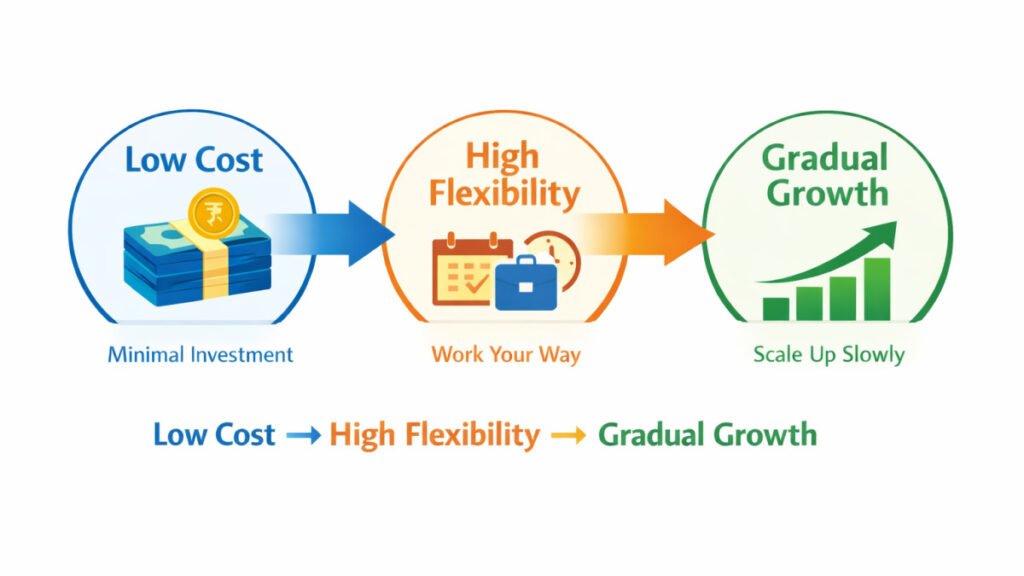
You can test an idea without risking lifetime savings.
Failure here is learning, not disaster.
✅ 2. Flexible Working Hours
Perfect for:
- Homemakers
- Parents
- Students
- People managing health issues
You control when and how you work.
✅ 3. Faster Decision-Making
No bosses. No approvals.
You adapt quickly to market demand.
✅ 4. Scope for Gradual Scaling
Many successful brands started from homes and later moved to:
- Shops
- Warehouses
- Commercial kitchens
Home is stage one, not the final limit.
The Less-Talked-About Challenges of a Home Business
A home business is not easy money. Some real challenges:

❌ Discipline Issues
Home ≠ office.
Without routine, productivity suffers.
❌ Family Interruptions
Indian households often don’t understand “working from home” boundaries initially.
❌ Limited Space
Storage, packaging, noise, and hygiene rules can restrict growth.
❌ Legal & Compliance Confusion
GST, FSSAI, trade license—many beginners ignore this and face issues later.
👉 Tip: Treat your home business like a real business from Day One.
Types of Home Businesses in India (With Practical Insight)
1. Service-Based Home Businesses

Best for beginners with skills.
Examples:
- Freelancing (design, writing, accounting)
- Digital marketing services
- Online tutoring
- Consulting
Why good?
- Zero inventory
- High margins
- Skill-based income
2. Food-Based Home Businesses

Very popular but regulated.
Examples:
- Homemade snacks
- Cloud kitchen
- Baking & desserts
- Ready-to-cook mixes
⚠ Requires:
- FSSAI registration
- Hygiene discipline
- Consistency
3. Product-Based Businesses

Needs inventory & logistics.
Examples:
- Handmade soaps, candles
- Clothing & tailoring
- Agarbatti, spices
- Reselling via Meesho/WhatsApp
📦 Storage & packaging planning is critical here.
4. Digital Asset Businesses

Long-term income focus.
Examples:
- Blogging
- YouTube
- Online courses
- Affiliate marketing
⏳ Takes time but scalable globally.
Who Should Start a Home Business? (Reality Check)
👍 Ideal For:
- People who are willing to learn continuously
- Those comfortable with uncertainty
- Self-motivated individuals
- Anyone wanting controlled risk
- People who can wait 6–12 months for results
👎 Not Ideal For:
- People expecting instant income
- Those avoiding responsibility
- Anyone unwilling to adapt or market themselves
How much money can you actually earn from a home business in India?
The reality is there is no fixed amount. Your income depends on what kind of business you choose and how seriously you are working on it.
For example, freelancers often can earn anywhere between 15,000 to 1.5 lakh rupees a month, while a small home based food business can bring in 20,000 to 2 lakh rupees if managed well. Blogging or YouTube may start slow at around 10,000 rupees, but with consistency, some people cross 5 lakh or more per month.
💡 finally success depends less on the idea itself and more on how well you execute it.
Legal Basics You Should Not Ignore
Depending on your business:
- GST Registration
- FSSAI License (Food)
- Current Account
- Trade License (local rules)
Also you can check platforms like Startup India and MSME Udyam Registration for free guidance.
Final Thoughts: Is a Home Business Really Worth It?
A home business is not some overnight success formula, but it is one of the safest ways to test the waters of entrepreneurship in India.
You get the chance to try, learn, and even make mistakes without risking a lot of money. Over time, you build confidence, start earning consistently, and grow at a pace that feels comfortable for you, not forced.
And in today’s India, starting small doesn’t mean thinking small, it means starting smart.